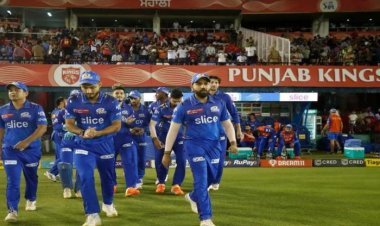
ICC is going to start strict rules in cricket from today, know what is this new 'stop clock' rule
Stop Clock Rule in International Cricket: In international cricket, time is fixed for the innings in limited overs format, but nowadays it is seen that the innings are ending much later than the scheduled time. Regarding this, ICC has brought a new rule of stop clock.
 Muskan
In international cricket, there is a fixed time for the innings in the limited overs format, but nowadays it is seen that the innings are ending much later than the scheduled time. The biggest reason for this is the time taken between overs. To limit this time, ICC has come up with the rule of 'Stop Clock', which will be tested in the T20 International series played between West Indies and England. Giving information, the ICC said that the trial of the stop clock rule will begin with the first T20 International to be played between West Indies vs England in Barbados on Wednesday.
The ICC has issued a statement saying that the stop clock rule aims to limit the time taken between overs. That means the bowling team will have to bowl the first ball of the next over within 60 seconds of the end of the over. If this is not done twice in the innings, a penalty of 5 runs will be imposed on the fielding team for the third time.
ICC General Manager of Cricket Wasim Khan said that we are looking for ways to increase the pace of play in all formats of international cricket. He said that before the stop clock trial in white ball cricket in 2022, new elements of play were successfully implemented. Under this, if the fielding team is not in a position to bowl the first ball of the last over within the stipulated time, only 4 fielders can be kept outside the circle. He said that it would be assessed after the trial of the stop clock rule.
During the innings, if the bowler is not ready to bowl the next over within 60 seconds, the umpire will warn twice and on doing so for the third time, 5 runs will be added to the batting team's account as a penalty.
At the same time, this rule will be applicable for batsmen also. If the second batsman does not come to the crease within two minutes and play the first ball after the wicket falls or is retired hurt, he will be considered out. If he is out in this manner, he will be declared time out. These special rules will remain applicable in ODI and T20I matches to be played till April 2024.